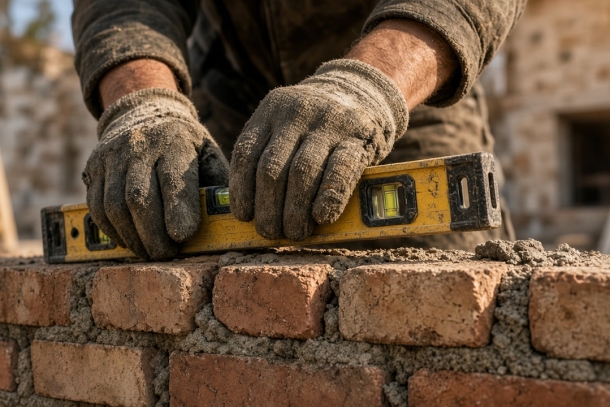
You walk onto a site, look at something, and your gut says: that’s not right. That instinct doesn’t come from a textbook. It comes from hands-on site experience, built up one job at a time.
I have a saying for it: if it smells like a fish, it definitely is a fish. When you’ve been in the game long enough, you stop second-guessing yourself.
But nobody is born with that feeling. Mine was paid for. Early lessons, like the time I went down a rabbit hole and had to replace planks and decking because I’d misread the problem, are exactly what that instinct is made of.
Every mistake you learn from on site is a deposit. Over time, it compounds.
Construction is a practical industry. Buildings are put together by people, materials and sequences that behave differently from one site to the next. That is why hands-on site experience is so valuable. It isn’t just a collection of years. It builds on itself, project after project.
Hands-on site experience builds pattern recognition
The first time you see a problem, you have to work it out from scratch. The second time, you recognise it sooner. By the tenth time, you often see it coming before it happens.
Experienced project managers walk onto a site and notice things: a delivery that is going to block access next week, a trade that is falling behind, a detail on the drawings that won’t work in practice. That isn’t magic. It’s pattern recognition built from being on site, watching work happen and seeing the consequences of decisions.
Every project adds to the next
Each project leaves you with something useful:
- A better sense of how long tasks really take
- An understanding of which details cause trouble
- Knowledge of suppliers, lead times and what can go wrong with deliveries
- Experience in handling clients, subcontractors and difficult conversations
- A clearer picture of where costs tend to creep
On its own, any one of these is small. Added together over many projects, they make a project manager faster, calmer and more reliable. That is what compounding means. Each lesson makes the next one easier to learn and apply.
You learn what the drawings don’t show
Drawings and specifications describe what should be built. Site experience teaches you how it actually gets built. You learn how trades sequence their work, where tolerances matter, what happens when the weather turns and how a small change in one area affects three others.
That practical understanding helps a project manager ask the right questions early, plan more realistically and earn the respect of the people doing the work.
Understand it before you fix it
The most expensive lesson hands-on experience teaches is also the simplest: you must always understand what you’re doing.
When something goes wrong on site, there’s huge pressure to act. The client is watching, the trades are waiting and the programme is ticking. It’s tempting to grab the first explanation that fits and start fixing.
That’s how you end up going down a rabbit hole. You put the time and materials into fixing the wrong thing, and the real problem is still sitting there.
Experience slows you down in the right way. Before anything gets pulled out or replaced, an experienced project manager wants to know why it happened. That habit alone saves clients a lot of money.
Judgment grows with exposure
Construction is full of decisions made with incomplete information. Should we wait for the engineer or proceed with the next area? Is this supplier’s delay a one-off or a warning sign? Is this cost saving worth the risk?
Good judgment comes from having seen similar situations play out before. The more varied your hands-on experience, the better your instincts become, and the more confidently you can make the call.
Trust your gut, because you’ve earned it
There’s a point in every career where the instinct starts to arrive before the reasoning does. You can’t always explain straight away why something feels wrong. But it does, and more often than not, it is.
Newer project managers often ignore that feeling because they can’t back it up with a reason yet. Experienced ones learn to stop and look. If it smells like a fish, it’s worth finding out why.
That doesn’t mean acting on gut feel alone. It means treating it as a signal: slow down, look closer and ask more questions before you commit.
How to make experience compound faster
Experience only compounds if you learn from it. Simply being present isn’t enough. A few habits help:
- Reflect after every project. What went well? What would you do differently? Write it down.
- Ask why. When something goes wrong, look for the root cause, not just the quick fix.
- Spend time on site. Walk the work regularly. Talk to foremen and trades about what they’re seeing.
- Learn from others. Experienced colleagues have already made mistakes you can avoid.
- Seek variety. Different project types, clients and challenges broaden what you know.
- Keep records. Notes on lead times, costs and problems become a valuable reference.
Mistakes are part of the compounding
Nobody builds hands-on site experience without getting things wrong. The difference is what you do afterwards.
If you just fix the mistake and move on, you’ve paid for the lesson without collecting it. If you stop to understand what went wrong and why, it becomes part of what you know for the rest of your career.
That’s why I believe people need to make their own mistakes, within reason. It’s tough. But it’s the mistakes you’ve made yourself that you never forget.
Why clients benefit
For clients, a project manager with real site experience brings practical value. They anticipate problems, plan realistically, manage contractors confidently and protect the budget. Clients may never see the problems that were avoided, but they feel the difference in a project that runs smoothly.
Final thought
Hands-on site experience is one of the most valuable things a construction project manager can bring to a project. It grows with every site, every problem solved and every lesson learned, and it keeps compounding for as long as you keep paying attention.
Related reading: Judgment: A Project Manager’s Most Valuable Skill and Lessons Learned in Construction Project Management.
Planning a build, renovation or fit-out in Gauteng? Call or WhatsApp me on 082 44 00 421, email unclemerwe@gmail.com or visit my homepage to see how I work.