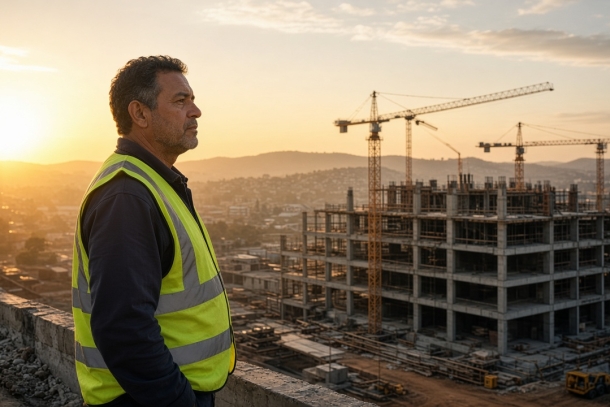
Construction has a way of teaching you things the hard way. Every project brings its own mix of people, problems and pressure, and over time the lessons start to repeat. The details change; the principles do not. These are the lessons learned in construction that I keep coming back to.
These are the lessons that hands-on experience has taught me about construction project management. Some I learned by watching good leaders. Others I learned by getting things wrong and having to put them right.
I never planned on this career. Years ago, in a previous job selling products, customers kept coming back to me with the same question: how do I install this? Fair enough, really. They started asking how I could be selling the stuff if I didn’t know how it went in.
So I did the only thing that made sense. I went and asked carpenters. How does it work? How does this go together? Why do you do it that way? I’d go around, watching, asking, just getting stuff done, and slowly but surely it started sinking in.
Then one day somebody said, “Hey, will you come and show my guy how to do this?” So I went. I didn’t really charge for that first one. It was all very laid back: yeah, sure, whatever.
But people kept asking me. Asking me, asking me, asking me. And that’s when it clicked: wait a minute, there’s a real need here. People need somebody who understands what’s going on, and they value that insight.
People don’t just need someone to do the job. They need someone who understands it.
Everything I know now came the same way: through hands-on experience, one question and one site at a time. Here’s what it has taught me.
Lessons learned in construction: the job is won before site starts
Early in a career it is easy to think that project management is mostly about what happens on site. It is not. Most of the problems I have had to solve on site were created months earlier: a brief that was never properly agreed, a budget with no contingency, a contract that did not say how variations would be handled, or a programme built on hope.
Now I spend far more time on the front end of a project. Getting the scope, budget, approvals and contract right is the cheapest risk management there is.
Problems do not get better with time
If there is one lesson I would give every new project manager, it is this: deal with problems the day you find them. A late delivery, a clash on the drawings, a trade that is falling behind, an unhappy client. Every one of these gets harder and more expensive the longer it is left.
Raising an issue early can feel uncomfortable. It is always less uncomfortable than explaining later why you knew and said nothing.
I learned this one with people, not paperwork. A driver who worked for me turned into a problem team member, and I left it too long. I needed him, so I let things slide.
Slowly but surely, it started eating away at the team. People didn’t like working with him. Morale dropped. And once morale goes, everything else on site starts going with it.
One bad apple, left alone, will spoil the whole crate.
Whether it’s a person, or something someone keeps doing wrong, don’t leave it long. It’s going to fester, and before you know it everything is going wrong, on the site and in your business.
People matter more than the programme
A programme is a plan. People deliver it. The projects that went best for me were not the ones with the most detailed schedules; they were the ones where the team trusted each other, raised problems openly and wanted the job to succeed.
That means knowing the foremen and the trades, being consistent with standards, giving credit where it is due and making decisions when they are needed. It also means remembering that everyone on site has pressures of their own.
Protect the client’s money like your own
Clients notice when you care about their budget. Questioning every variation, checking claims against work actually done, and making sure payments follow progress rather than dates are not just good practice. They are how you build the kind of trust that brings clients back.
I have also learned that the cheapest quote is rarely the cheapest project. Value comes from the right scope, the right contractor and the right decisions, not from the lowest number on a page.
Honesty is always the better option
There will be times when you have to tell a client something they do not want to hear: the programme has slipped, the cost has gone up, a decision they made is causing problems. Softening the message or delaying it never helps. Clients can handle bad news. What they struggle with is surprises.
I try to bring every problem with a clear explanation and a recommendation. That turns bad news into a decision instead of a crisis.
Calm is contagious, and so is panic
Sites are pressured places. When the project manager panics, everyone feels it. When the project manager stays calm, thinks clearly and focuses on what can be done next, the team usually follows.
Calm does not mean relaxed. It means not letting pressure make the decisions for you.
People sometimes ask me for the one time staying calm saved the day. Honestly? That’s every day.
I learned it early in life. My dad had a short temper. When things went wrong he’d shout, and I saw what happened next: people didn’t change what they were doing. They just waited for him to leave, then carried on.
Shouting doesn’t fix a site. People just wait for you to leave.
Staying calm is the number one key to success in my business. When something goes wrong, keep your head, check what’s really happening, and ask: why are we doing this, when we could be doing that?
Paperwork protects everyone
I used to see documentation as admin that got in the way of the real work. Experience changed my mind. Minutes, site instructions, variation approvals, inspection records and progress photos protect the client, the contractor and the project manager. When there is a disagreement months later, the written record is usually what settles it fairly.
Good paperwork is not about distrust. It is about making sure everyone remembers the same thing.
The last few percent define the project
Most projects look good at eighty or ninety percent complete. It is the final stretch that separates a professional job from an average one: snags closed out properly, certificates handed over, the client walked through the finished space and left confident.
How you finish is what people remember.
You never stop learning
Every project still teaches me something. New materials, new tools, new client expectations and new pressures in the market all mean the job keeps changing. The project managers I respect most are the ones who stay curious, ask for feedback and are willing to change how they work.
That is probably the biggest lesson of all. Experience is valuable, but only if you keep learning from it.
Related reading: What I Wish I Knew Earlier as a PM and Why Hands-On Site Experience Compounds.
Planning a build, renovation or fit-out in Gauteng? Call or WhatsApp me on 082 44 00 421, email unclemerwe@gmail.com or visit my homepage to see how I work.