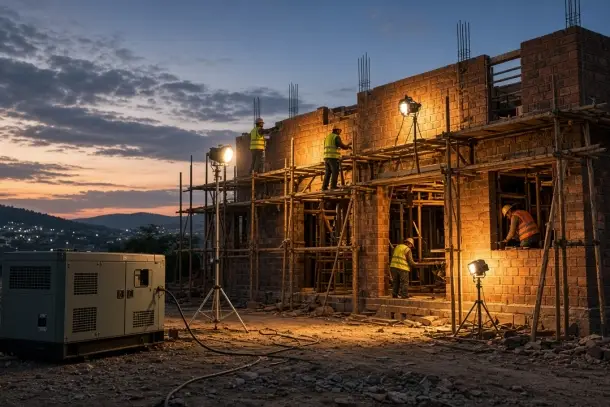
Power interruptions have been part of life in South Africa for years. Even when load shedding eases, outages from local faults, maintenance or cable theft can still hit a site without warning. On a construction project, lost power means idle teams, delayed trades and sometimes damaged work. The answer isn’t to hope for the best. It’s to plan for it. Here is how I approach load shedding on site.
How load shedding on site affects your project
Start by identifying which activities depend on electricity:
- Power tools for cutting, drilling and fixing
- Concrete vibrators, pumps and mixers
- Welding and steel fabrication
- Lighting for internal work
- Site offices, security systems and access control
- Testing and commissioning of electrical and mechanical systems
Some tasks can carry on without power. Others stop immediately. Knowing the difference is the foundation of a good plan.
Track schedules and plan around them
Where outage schedules are published, check them daily and build them into short-term planning. Schedule power-hungry tasks for periods when supply is expected, and use outage windows for work that doesn’t need electricity, such as setting out, inspections, deliveries, manual work or planning meetings.
Schedules can change at short notice, so planning should stay flexible.
Backup power options
Most sites need some form of backup power. Common options include:
- Generators. The most common choice for construction. Size them for the actual load and consider fuel use and storage.
- Inverters and batteries. Useful for lighting, site offices, security and small tools.
- Solar-assisted systems. Can reduce fuel costs on longer projects.
Talk to a competent electrical contractor about sizing, connection and safe changeover. An undersized generator causes as many problems as no generator at all.
Safety comes first
Generators and temporary power bring real risks:
- Place generators outdoors, away from openings, to avoid exhaust fumes building up
- Store fuel safely and keep fire extinguishers nearby
- Make sure connections and distribution boards are installed and checked by a competent person
- Prevent back-feeding into the supply
- Protect cables from damage and trip hazards
Protect critical activities
Some activities can’t be interrupted once started. Concrete pours, for example, should have reliable backup for pumps and vibrators, and suppliers should be confirmed. Plan these activities carefully and have a contingency ready.
Factor in cost and time
Backup power costs money: hire, fuel, maintenance and installation. Lost productivity costs money too. Include these in the budget and programme from the start, rather than treating them as surprises. Clients appreciate honest planning more than unexpected claims later.
Communicate with the team
Make sure subcontractors know the plan: when power is expected, what backup is available and what work to prioritise during outages. Good communication keeps teams productive instead of standing around waiting.
Plan the week, not just the day
Daily schedule checks help, but the real gains come from planning a week ahead. On a Gauteng site I like to sit down with the site manager at the start of each week and look at the programme alongside the expected outage pattern. Which days have the heaviest power-dependent work? Which trades can be moved around? What can be brought forward if a long outage hits?
A simple weekly look-ahead covers:
- The main activities planned for each day and whether they need power
- Which of those can move if supply is interrupted
- Deliveries that need power on arrival, such as pumps or lifting equipment
- Inspections and sign-offs that need lighting or testing equipment
- Who is responsible for starting and checking backup power each morning
This doesn’t need fancy software. A whiteboard in the site office or a shared document works, as long as everyone uses it.
Keep the generator running properly
A generator is only useful if it starts when you need it. Too often a unit sits idle for weeks, then fails the moment the power drops. Build a routine around it:
- Check fuel, oil and coolant at the start of each shift
- Test-start it regularly, even when power is on
- Keep a log of running hours and services
- Make one person responsible for it, with a back-up person named
- Secure it properly, because generators and fuel are targets for theft
Fuel management deserves its own attention. Agree how much fuel is kept on site, where it’s stored, who orders more and how usage is tracked. Running out of diesel halfway through a pour is the kind of problem that’s completely avoidable.
Protect work and materials, not just people
Power outages can damage work as well as slow it. Think about:
- Curing concrete that needs pumps or dewatering to keep excavations dry
- Materials that need refrigeration or controlled conditions
- Security systems and electric fencing that fail when power drops
- Lifts, hoists or temporary lighting in stairwells that leave people stranded or in the dark
Walk the site with these questions in mind and decide what needs to stay on backup and what can safely go off.
Write it into the contract and the programme
Load shedding on site isn’t only a site issue. It’s a commercial one too. Before work starts, be clear about who provides backup power, who pays for fuel and how lost time from outages is treated. Different contracts handle this differently, so read the terms carefully and agree the approach in writing.
On the programme, include realistic allowances rather than assuming full power every day. If the programme only works with uninterrupted supply, it isn’t a realistic programme.
Keep a record
Note outages in the site diary: when they started, how long they lasted, what work was affected and what backup was used. Good records make it much easier to discuss delays and costs fairly with the client later, and they help you plan better on the next project.
Final thought
Power outages are a known risk in South Africa, so they should be planned for like any other risk. With realistic scheduling, suitable backup power and a safety-first approach, a project can stay on programme even when the lights go out.
Related reading: Commercial Fit-out Timeline and Economic Pressure and Construction Project Risk.
Planning a build, renovation or fit-out in Gauteng? Call or WhatsApp me on 082 44 00 421, email unclemerwe@gmail.com or visit my homepage to see how I work.