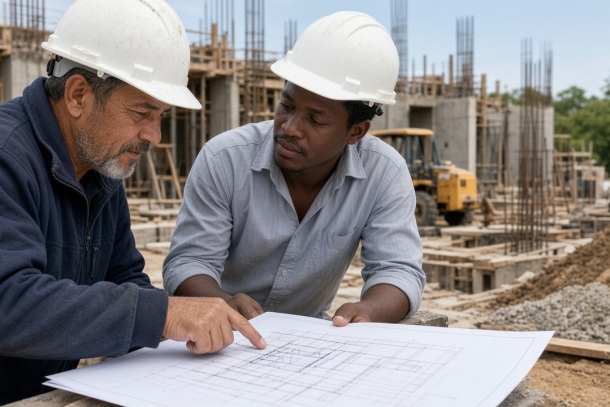
The best thing I’ve learned about developing junior project managers is also the hardest to do: let them make the mistake.
Everything in you wants to step in. I know that feeling well. For years I wanted to show everyone how to do it myself. But you need to let your team members do stuff and let them handle it.
Guide them. When it goes wrong, show them where, and how to grow from it. Then let them come to you and ask the question. That way the team grows, everyone learns, and the lesson sticks for the future.
Let them make the mistake. Then show them how to grow from it.
Every experienced project manager was shaped by someone. A site manager who insisted on standards, a mentor who explained the reasoning behind a decision, or even a bad boss who showed what not to do. Senior PMs today are doing the same for the next generation, whether they realise it or not. Developing junior project managers is part of the senior role.
People copy what they see
Junior team members learn far more from what senior people do than from what they say. If the project manager arrives prepared, follows up, treats trades with respect and owns mistakes, the team learns that this is normal. If the PM cuts corners or blames others, that becomes normal too.
Leading by example isn’t a slogan. On site, it’s the main way culture is passed on.
I learned that early, at home. My dad had a short temper, and people simply waited for him to leave before carrying on as they were. Shouting taught nobody anything. A calm, consistent example teaches far more than any lecture.
Setting standards
Senior PMs set the bar for quality, safety and professionalism. When they walk the site, what they notice and what they let slide tells everyone what really matters. Consistent standards, explained clearly, help younger professionals understand what good looks like.
Standards also have to be the same every day. If you insist on something on Monday and ignore it on Friday, people learn that the standard depends on your mood. Consistency is what makes a standard stick.
Developing junior project managers with real responsibility
People grow when they’re trusted with real work. That might mean letting a junior site manager run a coordination meeting, manage a subcontractor or own a section of the programme. The senior PM stays close enough to support, but far enough back to let them learn.
Real responsibility means real room to get it wrong. Not on safety or structural matters, where you step in straight away. But on the everyday decisions, letting a junior get it slightly wrong, and then talking it through, teaches more than doing it for them ever will.
It takes trust, and it takes patience. I still find it hard. But the people I’ve trained know what they’re doing, and they only got there because someone let them do the work.
Explaining the why
Instructions get tasks done. Explanations build understanding. When a senior PM explains why a sequence was chosen, why a risk matters or why a client conversation was handled a certain way, they’re passing on judgment, not just tasks.
Experience gives a senior PM a lot of patterns to pass on. After enough years you realise there’s very little that’s truly new on site. Sharing the reasoning behind a decision is how those patterns get passed on, instead of leaving with you.
Honest, respectful feedback
Feedback is how people improve. Good feedback is specific, timely and given with respect. Praise what was done well, be clear about what needs to change and help the person understand how to do it better next time.
Feedback after a mistake matters most of all. The aim isn’t to make anyone feel small. It’s to make sure the mistake is learned, so it isn’t repeated.
Making it safe to ask questions
Younger professionals often hesitate to ask questions, worried they’ll look inexperienced. Senior PMs who welcome questions and admit what they don’t know create teams that learn faster and raise problems earlier.
Let them come to you
One of the most useful things a senior PM can do is resist answering questions nobody has asked yet. If you hover with the answer, people never learn to find it themselves.
Instead, make it clear you’re available, then let them come to you and ask. When they do, they’ve already thought about the problem. That’s when your guidance lands best.
Over time, the questions change. They get sharper, then less frequent. That’s how you know someone is growing.
The takeaway is simple. Developing junior project managers isn’t about having all the answers ready. It’s about giving people real work, letting them make the mistake, and being there with guidance when they come to you. Do that consistently and you won’t just finish your own projects well. You’ll leave behind people who can run the next ones.
Make time for it
Developing people doesn’t happen by accident. On a busy site, the days fill up quickly, and the first thing to go is the time spent explaining, reviewing and coaching. If it matters, it has to be planned.
Simple habits help:
- A short walk-through of the site with a junior at the end of the day
- Inviting them into client and consultant meetings, then talking it through afterwards
- Giving them a piece of the programme or a trade package to own
- Asking them to explain a decision back to you in their own words
None of this takes much time on its own. Done consistently, it adds up to real growth.
Final thought
The next generation of site and project leaders is being shaped on today’s sites. Senior PMs have a real opportunity, and responsibility, to pass on good habits, high standards and sound judgment. The industry will be better for it.
Related reading: Mentorship in Construction, Teaching Without Micromanaging and The Responsibility That Comes with Experience.
Planning a build, renovation or fit-out in Gauteng? Call or WhatsApp me on 082 44 00 421, email unclemerwe@gmail.com or visit my homepage to see how I work.