There was a time when a construction project manager could get by with a diary, a printed programme and a phone full of contacts. Some still try. But the projects I see today, whether a home renovation in Gauteng or a commercial fit-out with a hard opening date, generate far more information than any paper system can manage well. Drawings change, decisions pile up, photos multiply and clients expect quick, clear updates. These are the digital skills for project managers that I see making the biggest difference.
Digital skills are no longer a nice extra for project managers. They are part of the core job. The good news is that you don’t need to be a software expert. You need to be competent with a handful of tools and, more importantly, disciplined in how you use them. This article covers the digital skills I believe every modern project manager should master.
Digital skills for project managers: scheduling
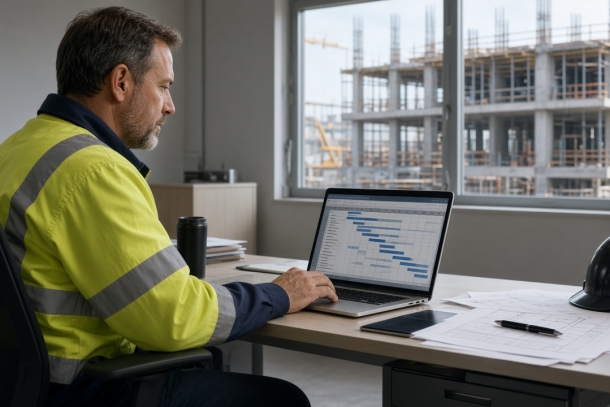
The programme is the backbone of every project. Being able to build, update and communicate a programme in scheduling software is one of the most valuable digital skills a PM can have. That means more than drawing bars on a chart. It means understanding dependencies, identifying the critical path, tracking progress against a baseline and showing the effect of delays.
A good digital programme lets you answer the questions clients actually ask: When will it finish? What happens if this item is late? What do we need to decide this week to stay on track? If your programme can’t answer those questions quickly, it’s just a picture.
Document control
Construction runs on documents: drawings, specifications, revisions, RFIs, site instructions, variation orders, certificates and correspondence. One of the most common causes of mistakes on site is someone working from an old drawing.
Digital document control means everyone works from a single, current set of information, with clear revision tracking and a record of what was issued to whom and when. Whether you use a dedicated platform or a well-organised shared drive, the skill lies in setting up a clear structure, naming files consistently and making sure superseded documents are clearly marked. It’s not glamorous, but it prevents expensive errors.
Cost tracking and spreadsheets
Every project manager should be comfortable with spreadsheets. Budgets, cost reports, cash-flow forecasts, variation registers and payment schedules are often managed in spreadsheets, even when other systems are in place.
Being able to build a clear cost tracker, link figures correctly and present the budget position in a way a client understands is a practical, everyday skill. It also helps you spot problems early, such as a growing list of variations or a trade package trending over budget.
Photo and progress reporting
A smartphone is one of the most powerful tools on site. Dated, well-labelled photos are a record of progress, quality and conditions. They help resolve disputes, support payment claims, document work before it is covered up and keep remote clients informed.
The skill lies in being systematic: taking photos at consistent points, labelling them by date and area, and storing them where the team can find them. Combined with short written notes, photo reports give clients confidence and give you a reliable record when questions come up months later.
Clear digital communication
Email, messaging apps and collaboration platforms make communication faster, but they also make it messier. Important decisions get lost in long group chats. Instructions are given by voice note and never confirmed. Clients receive too many messages and stop reading them.
A modern PM needs the discipline to use digital communication well: confirming decisions in writing, keeping project correspondence organised, using clear subject lines and knowing when a phone call or meeting is better than another message. Writing short, clear updates is a digital skill in its own right.
Meeting management and action tracking
Digital tools make it easier to record meetings, capture actions and track them to completion. A simple shared action list, updated after every meeting and reviewed at the next one, can transform accountability on a project.
The skill isn’t the software. It’s the habit of recording who agreed to do what by when, sharing it promptly and following up consistently.
Reading digital drawings and models
Drawings are increasingly shared as PDFs and digital models rather than paper sets. Being able to navigate digital drawings, take measurements, mark up comments and compare revisions saves time and reduces errors. On larger projects, a basic understanding of building information models helps you coordinate services and spot clashes before they reach site.
You don’t need to be a draughtsperson, but you should be confident opening, reviewing and commenting on the digital information your consultants produce.
Data security and good digital habits
Projects hold sensitive information: client details, contract values, banking details and access arrangements. Payment fraud using fake invoices or changed banking details is a real risk in construction. Basic digital hygiene, such as verifying changes to banking details by phone, using strong passwords and controlling access to shared folders, protects both you and your client.
Learning new tools quickly
Software changes constantly. The specific tools you use today may not be the ones you use in five years. Perhaps the most important digital skill is the willingness to learn: trying new tools, understanding what problem they solve and deciding whether they genuinely improve how the project runs.
Not every new app is worth adopting. A good PM evaluates tools by a simple test: does this make the project clearer, faster or more controlled, or does it just add another place to check?
Technology supports judgment, it doesn’t replace it
It’s worth saying clearly: digital tools don’t manage projects, people do. A beautiful programme is useless if the durations are unrealistic. A cloud platform won’t help if nobody uploads the latest drawings. Software makes good project management more efficient and more visible, but it can’t replace site knowledge, experience and judgment.
The best modern project managers combine both. They know how buildings go together and how people work on site, and they use digital tools to organise information, communicate clearly and keep everyone aligned.
Where to start
If you feel behind on digital skills, start small:
- Get comfortable updating a programme and showing progress against a baseline
- Set up a clear folder structure and file naming system for every project
- Build a simple cost tracker and variation register
- Take and label progress photos consistently
- Confirm every important decision in writing
These habits alone will put you ahead of many projects I’ve seen, and they’ll make your clients’ lives easier.
Related reading: The Rise of Digital Project Managers and AI in Construction Project Management.
Planning a build, renovation or fit-out in Gauteng? Call or WhatsApp me on 082 44 00 421, email unclemerwe@gmail.com or visit my homepage to see how I work.