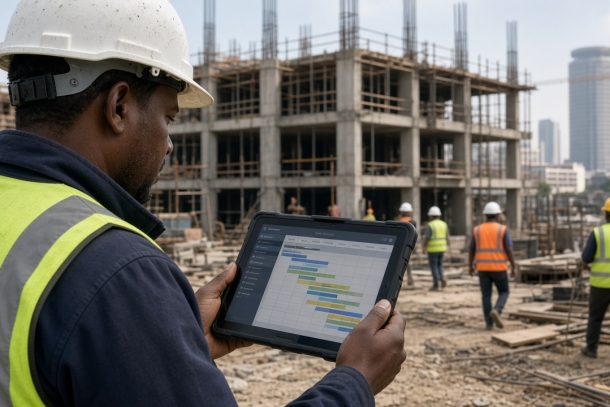
For a long time, a lot of construction sites were run on what I call chaos management. Information lived in someone’s head, in a notebook or in a long chain of WhatsApp messages. Programmes were printed once and never updated. Decisions were made in the car park and forgotten by the next meeting. When something went wrong, the project manager who shouted the loudest and worked the longest hours was seen as the hero. Digital project managers are changing that picture.
That way of working is fading, and I think that is a good thing. A new kind of project manager is taking over: one who uses digital tools to see problems earlier, share information faster and make decisions based on facts instead of memory. I call them digital PMs, and in my hands-on experience they run calmer, more predictable projects.
What chaos management looks like
Most people who have worked in construction will recognise it. The latest drawing revision is not the one on site. The client asks for a cost update and it takes three days to put together. A subcontractor arrives for work that cannot start because the previous trade has not finished, and nobody told them. Snag lists are written on paper, photographed, lost and rewritten.
None of this is caused by bad people. It is caused by information that is scattered, out of date or invisible to the people who need it. The result is constant firefighting, long days and a project that feels out of control even when it is broadly on track.
What digital project managers do differently
A digital PM is not someone who loves gadgets. It is someone who uses simple tools consistently to keep one version of the truth that everyone can see.
In practice that usually means:
- A live programme that is updated regularly, not a printout from the first week
- A single place for current drawings and documents, with old revisions clearly superseded
- Site diaries, progress photos and inspection records captured on a phone and stored properly
- A shared register for risks, requests for information, variations and snags, with owners and due dates
- Cost reports that can be updated quickly because the data is already organised
None of these tools are new or exotic. What makes the difference is the discipline of using them every day, so that the information is always current.
Seeing problems earlier
The biggest advantage of working digitally is visibility. When the programme is live and progress is recorded against it, slippage shows up in days rather than weeks. When long-lead items are tracked against required-on-site dates, you know which orders are at risk before they become emergencies. When the variation register is up to date, you can tell a client exactly where the budget stands.
That early warning is what replaces firefighting. You still have problems, every project does, but you deal with them while there are still options.
Better communication with less noise
Digital tools also change how a project communicates. Instead of a dozen people asking the PM the same question, they can check the shared record. Instead of a long email describing a defect, a photo with a location and a note does the job. Instead of arguing about what was agreed in a meeting, the action list is there for everyone to see.
For clients this is reassuring. A homeowner or a retailer who can see clear, regular progress reports with photos trusts the process more. For directors, it means reporting that is consistent across projects.
Technology does not replace judgment
I want to be clear about one thing. Digital tools do not make anyone a good project manager on their own. A beautifully formatted programme is worthless if the logic behind it is wrong. A dashboard full of data does not help if nobody acts on it. Software cannot walk the site, read the mood of a team or have a difficult conversation with a client.
The best digital PMs I know use technology to free up time for the things that need a person: thinking ahead, leading people and making decisions. The tools handle the admin so the PM can do the job.
The South African reality
On local sites, going digital also has to be practical. Connectivity is not always reliable, power interruptions still happen, and not every subcontractor works the same way. The tools that work best are simple, work on a phone and can cope with being offline for a while. A system that only one person on the project understands is not a system at all.
I also think it is important to bring the whole team along. Showing a foreman how to log progress photos, or giving subcontractors a clear way to see the look-ahead programme, often makes a bigger difference than buying expensive software.
Why this matters for careers
For project managers, especially those earlier in their careers, digital skills are no longer optional extras. Clients, directors and recruiters increasingly expect a PM to be able to produce clear reports, maintain a live programme and manage information properly. Those who can do that alongside solid site experience stand out.
Chaos management might still get a project finished. But digital PMs get projects finished with fewer surprises, less stress and a clear record of what happened. That is the direction our industry is moving, and I believe it is the right one.
Related reading: Digital Skills for Project Managers, Construction Is Changing and AI in Construction Project Management.
Planning a build, renovation or fit-out in Gauteng? Call or WhatsApp me on 082 44 00 421, email unclemerwe@gmail.com or visit my homepage to see how I work.