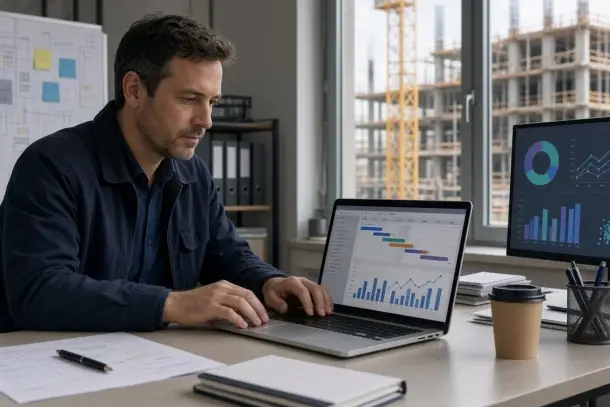
AI in construction project management is moving from talk to practical tools. Many project managers wonder what it means for their careers. Will AI replace PMs, or make them more effective?
The honest answer is that AI is likely to change parts of the job, not replace the role.
What AI in construction project management can help with
AI and automation tools are increasingly used for tasks such as:
- Drafting reports, minutes and emails
- Summarising documents and contracts
- Organising photos and site records
- Flagging programme or cost risks from data
- Searching drawings and specifications
- Scheduling and resource planning support
These tasks take time. Automating parts of them frees PMs for higher-value work.
What stays human
Some parts of project management depend on people:
- Building trust with clients and teams
- Negotiating variations and resolving disputes
- Making judgment calls with incomplete information
- Leading people under pressure
- Understanding what’s really happening on site
- Taking responsibility for decisions
AI can support these, but it can’t own them.
The risks to watch
AI tools can make mistakes, miss context or produce confident-sounding but wrong answers. PMs must check outputs, protect confidential information and stay accountable for decisions.
How to prepare
- Experiment with AI tools on low-risk tasks
- Learn to check and correct AI outputs
- Keep strengthening leadership, communication and commercial skills
- Keep records organised, because good data makes tools more useful
- Stay curious and keep learning
Where AI fits in a normal week
It helps to think about where a project manager’s time actually goes. A big share of it is admin: writing up minutes, chasing information, preparing reports, checking documents and answering the same questions more than once. That’s where AI in construction project management can make the biggest practical difference.
Some sensible starting points:
- Turning rough meeting notes into clear minutes with action items
- Drafting a first version of a progress report from your site notes
- Summarising a long specification or contract clause so you know where to look
- Checking an email for tone before it goes to a client
- Creating checklists for inspections, handover or procurement
In every case, the tool gives you a first draft. You still check it, correct it and own it.
Why judgment matters more, not less
When drafting and summarising get easier, the value moves to the parts that can’t be automated. Anyone can produce a neat report. Not everyone can tell from a site walk that a trade is falling behind, that a client is worried about something they haven’t said, or that a supplier’s promises don’t add up. That kind of judgment comes from time on site, and it becomes more valuable as the paperwork gets easier.
Confidentiality and accuracy
Construction projects involve confidential information: client budgets, contracts, drawings and personal details. Before using any AI tool, understand where the information goes and whether your client or employer allows it. In South Africa, the Protection of Personal Information Act also applies when personal information is involved. When in doubt, leave sensitive details out.
Accuracy matters just as much. AI tools can produce answers that sound right but aren’t. Never rely on them for structural, legal, safety or compliance decisions without checking with the right professional and the actual documents.
Will it affect jobs?
Some tasks will take less time, and roles will change. People who only do repetitive admin may feel the pressure most. But construction is still a hands-on, people-driven industry. Projects still need someone to lead, coordinate, negotiate and take responsibility. Those are the skills worth investing in.
Practical advice for junior PMs
If you’re early in your career, use AI tools to learn faster, not to skip the learning. Ask a tool to explain a contract term, then check it against the contract. Use it to draft a report, then compare it to what you saw on site. And spend as much time as you can on site, because that’s where the experience that tools can’t replace is built.
Practical advice for senior PMs
If you’ve been in the industry a while, don’t dismiss these tools, and don’t overestimate them either. Try them on your own admin first. Once you understand what they do well and where they fall short, you’ll be in a much better position to guide your team on how to use them responsibly.
A simple way to start
If you haven’t used AI tools at all, start small. Pick one repetitive task you do every week, such as writing up meeting minutes. Try using a tool to produce the first draft, then compare it with what you’d normally write. Note what it gets right, what it misses and how long the checking takes. After a few weeks, you’ll have a realistic sense of where it helps and where it doesn’t. That’s far more useful than either ignoring the technology or believing every claim made about it.
Whatever tools you use, the responsibility stays with you. If a report goes to a client with your name on it, you own every word, no matter who or what drafted it first.
Final thought
AI in construction project management is a tool, not a replacement. PMs who use it well will have more time for the parts of the job that matter most: people, judgment and delivery.
Related reading: Construction Is Changing and Digital Skills for Project Managers.
Planning a build, renovation or fit-out in Gauteng? Call or WhatsApp me on 082 44 00 421, email unclemerwe@gmail.com or visit my homepage to see how I work.