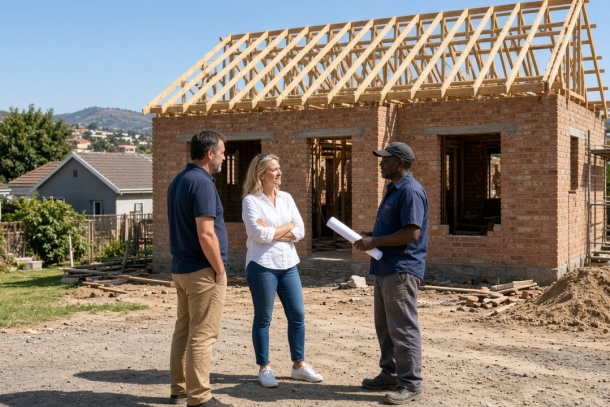
If you’re planning to build a new home in South Africa, you’ll come across the NHBRC: the National Home Builders Registration Council. Understanding what it does helps you choose the right builder and protect your investment. NHBRC enrolment is a key part of that protection.
This is a general overview. Always confirm current requirements with the NHBRC directly.
What is the NHBRC?
The NHBRC is a statutory body set up under the Housing Consumers Protection Measures Act. Its role is to protect housing consumers and regulate the home building industry.
Builder registration
In general, anyone who carries on the business of building new homes must be registered with the NHBRC. Before appointing a builder for a new home, ask for their NHBRC registration details and check that the registration is valid with the NHBRC.
NHBRC enrolment for your home
New homes generally need to be enrolled with the NHBRC before construction starts. Enrolment is the builder’s responsibility, and the enrolment fee is usually built into the building cost. Ask your builder to confirm that your home has been enrolled and keep a copy of the proof.
Banks commonly require proof of enrolment before releasing finance for a new home, so it’s worth sorting out early.
What enrolment gives you
Enrolled homes fall under the NHBRC’s warranty scheme, which covers certain defects for set periods after completion, including major structural defects. The details of what is covered, for how long and how to claim are set by the NHBRC, so check their current guidance.
Inspections
The NHBRC may carry out inspections at stages during construction. These don’t replace the municipal building inspections or the oversight of your own professionals.
Does it apply to renovations?
The enrolment requirement is aimed at new homes. Alterations and additions to an existing home are usually treated differently, but municipal approval and building regulations still apply. If you’re unsure, check with the NHBRC and your municipality.
Questions to ask your builder
- Are you registered with the NHBRC, and what is your registration number?
- Will you enrol my home before construction starts?
- Can I have a copy of the enrolment certificate?
- How will you handle defects after completion?
Why NHBRC enrolment matters to you
It’s easy to see NHBRC enrolment as just another piece of paperwork. It isn’t. For a homeowner building a new house, it’s one of the few formal protections that sit behind the builder. If something serious goes wrong with the structure after you move in, enrolment is what gives you a route to raise it.
It also tells you something about the builder. A builder who registers properly, enrols homes on time and gives you the paperwork without fuss is usually a builder who runs the rest of the project properly too.
How to check a builder’s registration
Don’t rely only on a certificate shown to you on a phone or a photocopy. Check the registration directly with the NHBRC using their official channels. Confirm:
- That the registration is current, not expired
- That the name on the registration matches the company or person you’re contracting with
- That the details match the contract you’re about to sign
If the builder is unwilling to give you their registration details, treat that as a warning sign.
Timing matters
Enrolment needs to happen before construction starts. Ask about it early, ideally before you sign the building contract, and make the proof of enrolment part of what you expect before work begins on site. If you’re using bank finance, speak to your bank early about what it needs, so there are no delays when the first payment is due.
Keep good records
Keep a file for your new home with:
- The builder’s NHBRC registration details
- The enrolment certificate for your home
- The building contract and approved building plans
- Inspection records and certificates issued during construction
- Correspondence about defects, both during and after construction
If you ever need to raise a defect or sell the house, these records make life much easier.
NHBRC enrolment and your own checks
NHBRC enrolment and inspections are a protection, not a replacement for your own care. You still need approved building plans, a proper contract, the required certificates for electrical and plumbing work, and someone keeping an eye on quality during the build. Think of the NHBRC as one layer of protection among several.
Common misunderstandings
- “My builder said it’s included, so I don’t need to check.” Always ask for proof.
- “The NHBRC inspected, so the work must be fine.” Inspections are a check, not a guarantee of everything.
- “It covers every defect.” Cover is limited to what the NHBRC scheme sets out, so read the details.
- “It applies to my renovation.” Alterations are usually treated differently, so check before assuming.
Building with a plan, not just a hope
Building a new home is exciting, and it’s easy to get caught up in the design and finishes. But the paperwork protects everything else. Before the first trench is dug, you should be able to say yes to these:
- I’ve checked my builder’s NHBRC registration myself
- My home will be enrolled before construction starts, and I’ll get the proof
- My building plans are approved by the municipality
- I have a written contract that covers scope, price, payments and defects
- I know who is checking quality on my behalf during construction
If you can tick all of these, you’ve already avoided many of the problems homeowners run into.
Final thought
NHBRC registration and enrolment are important protections for homeowners building a new house. Check them before construction starts, not after.
Related reading: SANS 10400 in Plain English and How to Choose a Building Contractor.
Planning a build, renovation or fit-out in Gauteng? Call or WhatsApp me on 082 44 00 421, email unclemerwe@gmail.com or visit my homepage to see how I work.