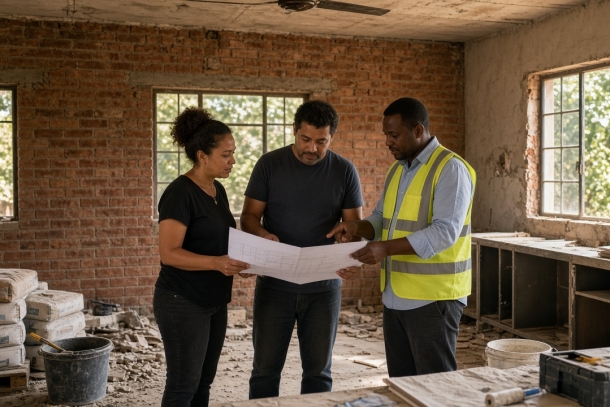
Most renovations that go wrong in South Africa do not fail on site. They fail in the weeks before anyone picks up a tool: a vague brief, a budget with no breathing room, plans that were never submitted, or a contractor appointed on a handshake. As a construction project manager, I am often called in once those problems have already cost money. This guide sets out the order I follow so you can avoid them from day one. If you want to plan a home renovation properly, start here.
Step 1 to plan a home renovation: write a clear brief
Before you speak to a builder, write down what you want and why. Which rooms are affected? What must the finished space do for you: more light, an extra bedroom, a kitchen you can actually cook in? List your must-haves separately from your nice-to-haves, and add photos of finishes you like.
A one-page brief does more to control cost than any negotiation later. Every contractor prices the same scope, and you have something to measure changes against when the “while we’re at it” ideas start.
Step 2: Set a realistic budget, including contingency
Your budget is not just the builder’s quote. It should cover professional fees (architect or draughtsperson, an engineer if structural work is involved, and a project manager if you use one), municipal submission fees, the building work itself, finishes and fittings you buy directly, and a contingency for the unknowns you only find once walls are opened.
Older homes in particular hide surprises in wiring, plumbing, roofs and foundations. Decide your ceiling first, then shape the scope to fit it, not the other way round. And treat the contingency as protection for genuine surprises, not as spending money for upgrades.
Step 3: Check whether you need approved building plans
In South Africa, building work is governed by the National Building Regulations and Building Standards Act, with SANS 10400 setting out the technical requirements, and plans are approved by your local municipality. As a general rule, extensions, new rooms, structural changes and many alterations to the outside of a house need approved plans before work starts. Some smaller work may qualify as minor building work, which usually still needs the municipality’s permission.
Building without approval can lead to fines, orders to alter or demolish, insurance problems and delays when you sell. Processes differ between municipalities, whether you are in Johannesburg, Tshwane or Ekurhuleni, so check with yours or ask a registered professional before you assume you are exempt. If you live in an estate or complex, the HOA or body corporate will usually have its own approval process too, and it often has its own rules on working hours and contractor access.
Step 4: Get the design and documentation right
Once the brief and budget are set, a registered architectural professional can draw up plans, and an engineer can design anything structural. Ask for a schedule of finishes and a simple specification alongside the drawings.
The more precisely the work is documented, the more comparable your quotes will be, and the fewer “extras” will appear on site. Vague items like “tiling as discussed” are where budgets quietly leak.
Step 5: Compare at least three like-for-like quotes
Send the same drawings, specification and brief to at least three contractors. Then compare more than the bottom line: what is included and excluded, provisional sums, the proposed programme, payment terms, and who supplies what.
A quote that is far cheaper than the rest usually means something is missing. Check references, visit a recent job if you can, and confirm the contractor carries suitable insurance. Ask who will actually be running your site day to day, because that person matters more than the salesperson you met.
Step 6: Sign a proper building contract
A quote is not a contract. Put the agreement in writing: scope, price, programme, a payment schedule linked to completed work rather than dates, retention, how variations are approved and priced, and what happens if the job runs late.
For larger projects, industry standard forms such as the JBCC agreements are widely used in South Africa. For smaller work, a clear minor works agreement may be enough. Either way, avoid paying large deposits upfront for work that has not been done.
Step 7: Plan the programme around real life
Agree a realistic programme and stress-test it. Where will you live during the work? Are materials with long lead times, such as custom joinery, windows or imported tiles, ordered early enough? How will power interruptions affect work on site, and who pays for backup power if it is needed?
In Gauteng, the summer rains and afternoon storms can slow roofing, external plastering and earthworks, so timing those parts of the job sensibly helps. The builders’ holiday at the end of the year can also add weeks to a programme if you do not plan around it.
Step 8: Manage the site, not just the start date
Once work starts, someone needs to own the project: regular site meetings, quality checks before work is covered up, approving variations in writing, tracking costs against budget, and arranging municipal inspections where required.
At the end, walk the job with a written snag list. Only release the final payment and retention once items are fixed and any compliance certificates, such as the electrical Certificate of Compliance, are handed over.
When a project manager is worth it
If your renovation involves structural work, several trades, or a budget you cannot afford to lose control of, an independent construction project manager can pay for themselves by preventing just one bad decision. I sit on your side of the table, not the contractor’s, so my job is protecting your scope, budget and timeline from the first brief to the final snag.
Related reading: Renovation Cost in South Africa, Do I Need Building Plans in South Africa? and Renovation Mistakes That Blow the Budget.
Planning a build, renovation or fit-out in Gauteng? Call or WhatsApp me on 082 44 00 421, email unclemerwe@gmail.com or visit my homepage to see how I work.